Residential shelter planning · Clarksville, TN
FEMA safe rooms and ICC 500 storm shelters, explained
Shelter sales pages mention FEMA, ICC 500 and “tested” doors. Here is what those terms mean, what a label does and does not prove, and what to ask before you buy for a Clarksville home.
Get a Clarksville storm shelter quoteSafe room or storm shelter?
FEMA P-320 (December 2024) explains that both must meet ICC 500, the consensus storm-shelter standard. A FEMA safe room also meets FEMA’s more conservative funding criteria in FEMA P-361. For homes, the biggest difference is wind speed: FEMA recommends designing residential safe rooms for 250 mph tornado winds wherever you live, and requires it when FEMA money is used.
FEMA does not certify shelters
FEMA says it does not inspect, endorse, approve, certify or recommend contractors, firms or products, and firms are not allowed to claim “FEMA approved” or “FEMA certified.” Treat those phrases as a prompt to ask for the actual test and listing documents.
What the tests involve
The walls, roof and door of a prefabricated residential safe room must resist extreme wind pressure and the impact of a 15-pound 2x4 board travelling at 100 mph. FEMA notes ordinary steel doors used in houses cannot pass these tests.
Listed and labeled units
FEMA notes that the 2024 IRC and ICC 500-2023 require signed and sealed construction documents with each residential storm-shelter permit, unless the unit is a prefabricated model listed and labeled for ICC 500. FEMA suggests searching the ICC Evaluation Service directory for “ICC 500.” When P-320 was published in December 2024, FEMA knew of no in-ground or precast concrete units listed and labeled this way, so ask how any in-ground model demonstrated compliance.
Foundations and anchors
Prefabricated units usually exclude the foundation. FEMA warns many have been installed on unreinforced or under-reinforced slabs. ICC 500 requires the construction documents to show foundation requirements and anchor details, and requires a special inspection of anchors installed in existing concrete. In-ground units must also be anchored against groundwater uplift.
Read the label, then ask for the rest
FEMA says a safe-room door label should show ICC 500 testing for a 250 mph tornado wind speed, including the 15-pound 2x4 at 100 mph impact, plus the manufacturer’s third-party listing. A label only covers impact and pressure testing, so still ask about anchorage and the rest of the unit.
Above-ground safe room questions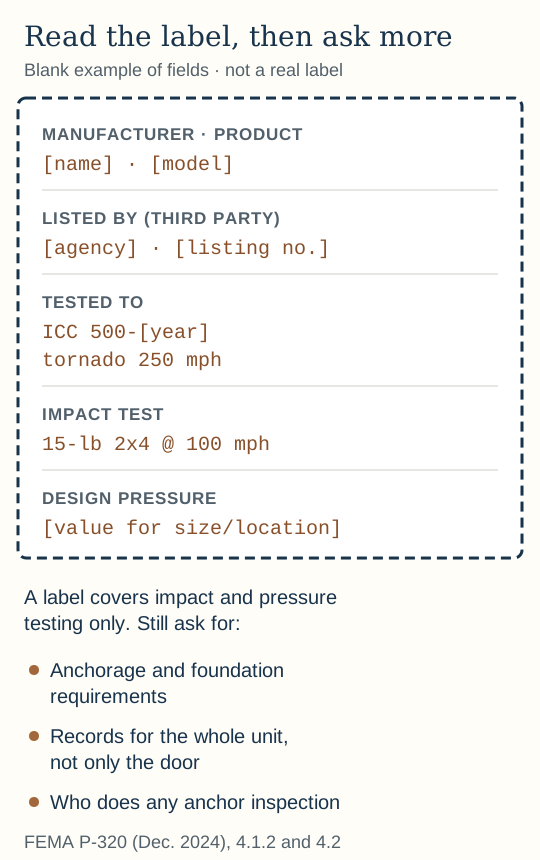
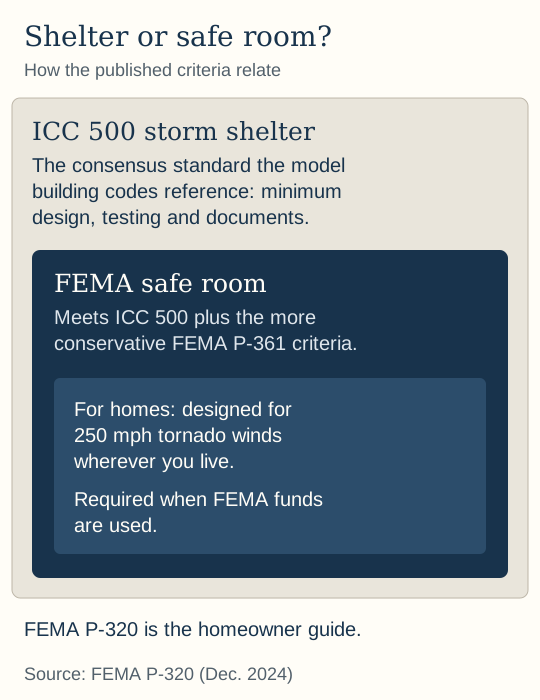
Shelter or safe room: how the criteria nest
Every storm shelter must meet ICC 500. A FEMA safe room meets ICC 500 plus FEMA P-361, which is more conservative. For homes, that includes designing for 250 mph tornado winds wherever you live.
How much room does your household need?
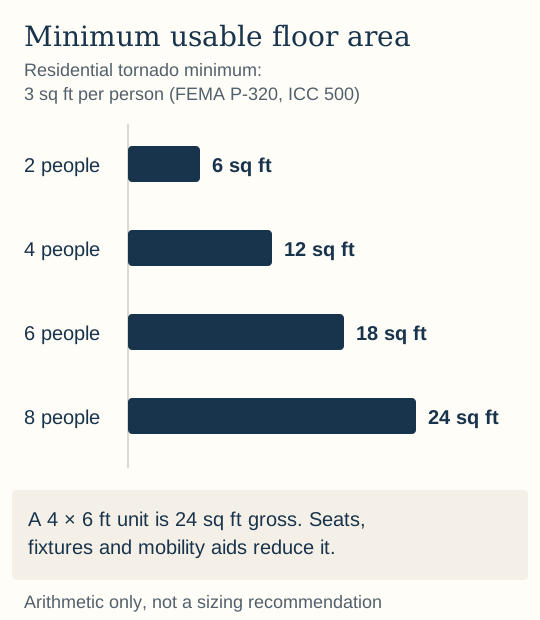
For tornado protection in a one- or two-family home, FEMA P-320 and ICC 500 set a minimum of 3 square feet of usable floor area per person. A residential safe room is limited to 16 occupants. Fixtures, benches and mobility aids reduce the usable space, so ask for the usable area, not only outside dimensions.
Foundations and anchors carry the load
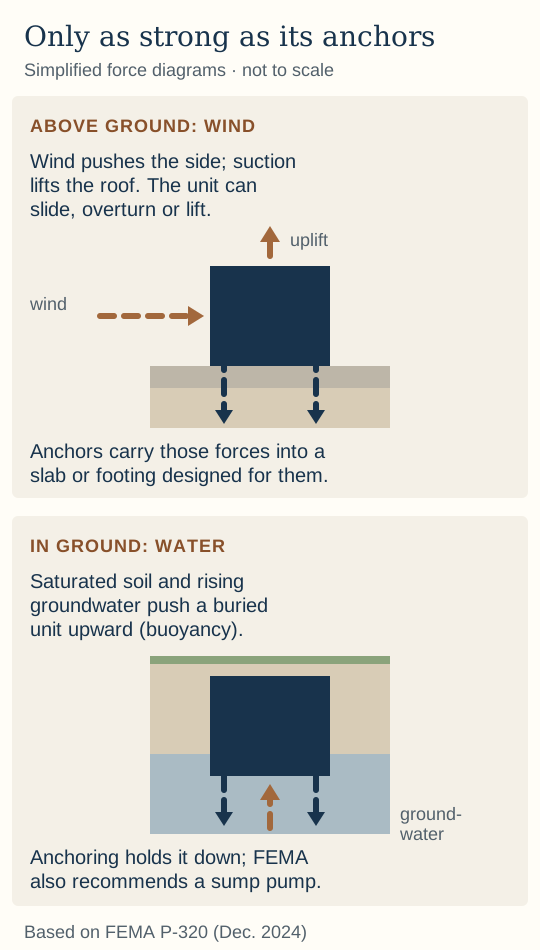
A tested unit is only as strong as its connection to the ground. Above ground, anchors resist sliding, overturning and uplift. In the ground, anchoring resists buoyancy from saturated soil and rising groundwater.
Which document answers which question?
On phones, each row is shown with its column labels.
| Consideration | Answers | Does not answer |
|---|---|---|
| Door or unit label | Impact and pressure testing, the standard and the listing agency | Whether your foundation and anchors are adequate |
| Test reports or listing report | How the exact model performed in testing | Site conditions at your address |
| Foundation and anchoring design | Slab, reinforcement and anchor requirements | Permit approval for your property |
| Permit and inspection records | What your building department reviewed and approved | Product claims beyond what was submitted |
Documents to request before you sign
Test or listing records for the exact unit
Door assembly label details, including the ICC 500 edition
Foundation and anchoring requirements for your location
Who performs any required special inspection
What the permit office needs: sealed documents or a listing
Usable floor area and design occupant capacity
Sources and further reading
Reviewed 2026-10-14
- FEMA P-320, Taking Shelter from the Storm (December 2024)
Primary source for this page: terminology, 250 mph criteria, testing, labels, foundations and sizing. Read directly October 14, 2026.
- ICC 500-2023 storm-shelter standard (publisher page)
- ICC Evaluation Service listing directory (search by standard)
Directory FEMA P-320 suggests for ICC 500 listed prefabricated shelters.
- State emergency-management FAQ: FEMA does not certify products or installers
Common questions
Is there such a thing as a FEMA-certified storm shelter?
No. FEMA says it does not approve, certify or recommend products or contractors, and firms may not claim to be “FEMA approved” or “FEMA certified.” Look for ICC 500 test and listing documents instead.
What is the difference between a safe room and a storm shelter?
Both must meet ICC 500. A FEMA safe room also meets FEMA P-361 criteria, which are more conservative; for homes that means a 250 mph tornado design wind speed regardless of location.
How can I tell if an existing storm shelter meets ICC 500?
FEMA does not inspect shelters. Check for labels and documents, ask your state hazard mitigation officer about qualified inspectors, or hire an independent registered design professional. The shelter’s age matters, since ICC 500 was updated in 2014, 2020 and 2023.
Does an interior closet count as a safe room?
Not unless it is built as one. FEMA notes closets and interior bathrooms can be good locations, but the room must be built to resist the full wind and debris criteria because the rest of the house may be destroyed.