Calculator · Shelter access planning · Clarksville, TN
How long to reach your storm shelter? Walk time planner
Enter the distance to your shelter, how fast your household really moves and the time you allow to gather and latch the door. The planner converts that to seconds and shows the 150 foot outdoor limit. Time a real practice run to replace the examples.
Get a Clarksville storm shelter quoteHow to use the planner
Pace the route from the nearest exterior door to the shelter opening, or from where you would be inside the house. Time a practice run with everyone who will use the shelter, then replace the example numbers. The time you allow before the storm is your own choice; no figure here is a forecast.
Walk time to shelter planner
ICC 500 requires a residential shelter’s access opening to be no more than 150 feet of travel from the nearest entrance of the home when the shelter is outside (FEMA P-320, section 3.5.2). The paces are round planning figures, not measurements of your household, and the gather, latch and warning values are examples. Replace all of them with times from your own practice. Warning times are not predictable, and when a tornado warning is issued the safe choice is to go at once, not to wait and compare numbers.
Results below use the example values shown. Turn on JavaScript to change them.
- Walking time
- 33 sec
- Total, alert to latched door
- 123 sec
- Warning time you entered (example)
- 300 sec
- Margin left
- 177 secNegative means over the time you entered
- Distance left under 150 ft
- 50 ftNegative means over
- Outdoor distance limit. The distance is within the 150 ft maximum travel distance ICC 500 sets for a shelter outside the house. If your shelter is inside the house, the limit does not apply but the route time still does.
- Your time budget. Your timed total fits inside the warning time you entered. Leave extra margin, because real warnings can be shorter or absent.
Planning arithmetic from your own numbers. It does not predict how much warning you will get, account for stairs, darkness, weather, debris or carrying a child or pet, or rule on whether a location complies. Distance is measured along the path you would walk.
Have your numbers? Get a quote for this fit
Seconds to walk common distances at each pace
On phones, each row is shown with its column labels.
| Distance | 2 ft per second | 3 ft per second | 4 ft per second |
|---|---|---|---|
| 25 ft | 13 s | 8 s | 6 s |
| 50 ft | 25 s | 17 s | 13 s |
| 100 ft | 50 s | 33 s | 25 s |
| 150 ft | 75 s | 50 s | 38 s |
Gathering and latching usually take longer than walking
Walking 100 feet at a steady pace takes about half a minute. Waking children, finding shoes, helping someone with a walker or a pet, and latching the door add far more, which is why the planner asks for them. FEMA advises placing the shelter so it can be reached quickly from all parts of the home and keeping it clear of clutter, and says people using an outdoor shelter must go early enough to avoid wind, debris and hail.
Clarksville tornado risk guide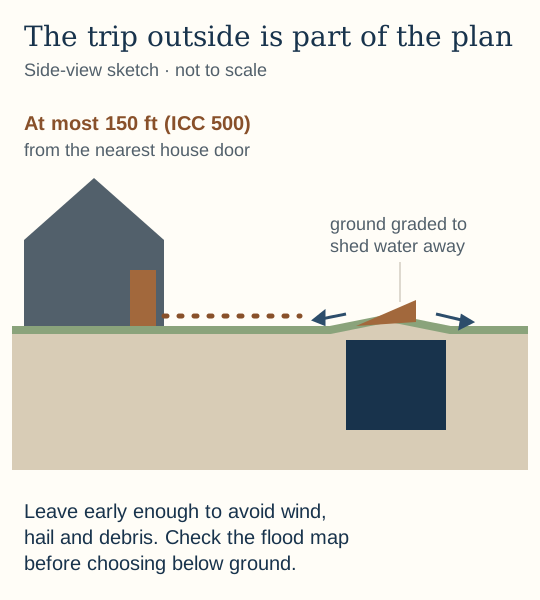
Time a practice run
Start from where you really are
Begin in the bedroom or living room, not at the exit door.
Include everyone
Time the slowest person, and anyone who must be helped or carried.
Walk the real route at night too
Try it with the lights off, in rain gear or with a flashlight, and note any step, threshold or gate.
Practice the door
Open, enter and latch it. Record the seconds.
Enter the times and repeat
Run the planner, then repeat the drill when the household or the route changes.
What this planner does not tell you
How much warning you will get
Lead time varies by storm and by location. No average is claimed here. Use a time you are prepared to rely on, and treat extra margin as a bonus.
Whether a location is approved
The permit office and the shelter’s documentation decide that. The 150 ft figure applies to a shelter outside the house.
Mobility and stairs
FEMA P-320 notes stairs in an in-ground shelter can slow someone using a wheelchair or crutches. Time that person yourself.
Conditions on the day
Rain, hail, darkness, debris and stress all slow people down.
Sources and further reading
Reviewed 2026-10-14
- FEMA P-320, Taking Shelter from the Storm (December 2024)
Section 3.5: locate the safe room so it can be reached quickly; ICC 500 150 ft travel limit; go early; accessibility and stairs. Read directly October 14, 2026.
- National Weather Service: tornado watch and warning definitions
Definitions and shelter instructions.
- Tennessee Emergency Management Agency: tornadoes
Go to the safe place when a warning is issued; keep shoes, a flashlight and supplies near it.
- Ready.gov: tornadoes
Identify and practice going to a safe shelter.
Common questions
How long does it take to walk 100 feet?
About 33 seconds at a steady 3 feet per second, 50 seconds at 2 feet per second and 25 seconds at 4 feet per second. These are round planning figures; time your own household, including the slowest member.
How much warning do you get before a tornado?
It varies by storm and place, and some tornadoes come with little or none. This site does not state an average. Use the planner with a lead time you are prepared to rely on, and keep extra margin.
What is the difference between a tornado watch and a tornado warning?
A watch means tornadoes are possible in and near the watch area. A warning means a tornado has been sighted or indicated by weather radar and there is imminent danger to life and property, per the National Weather Service.
When should I go to my storm shelter?
Go as soon as a tornado warning is issued, or earlier if you have decided to. TEMA says to go to your safe place immediately, and FEMA P-320 says people using an outdoor shelter should go early enough to avoid wind, debris, hail and rain.
Should I keep shoes and a flashlight near the storm shelter?
Yes. TEMA advises keeping shoes, a flashlight and emergency supplies near your safe place. Leave them where they can be grabbed without searching, and check them when you test the route.
What if someone in my home walks slowly or uses a wheelchair?
Time that person and use the slow pace or your own measured time. FEMA P-320 notes that stairs in an in-ground shelter can make access slower for wheelchair or crutch users, so compare step-free options and the route to each.